What are the 4 Types of Fuel Systems? A Simple Guide to Your Engine’s Heart
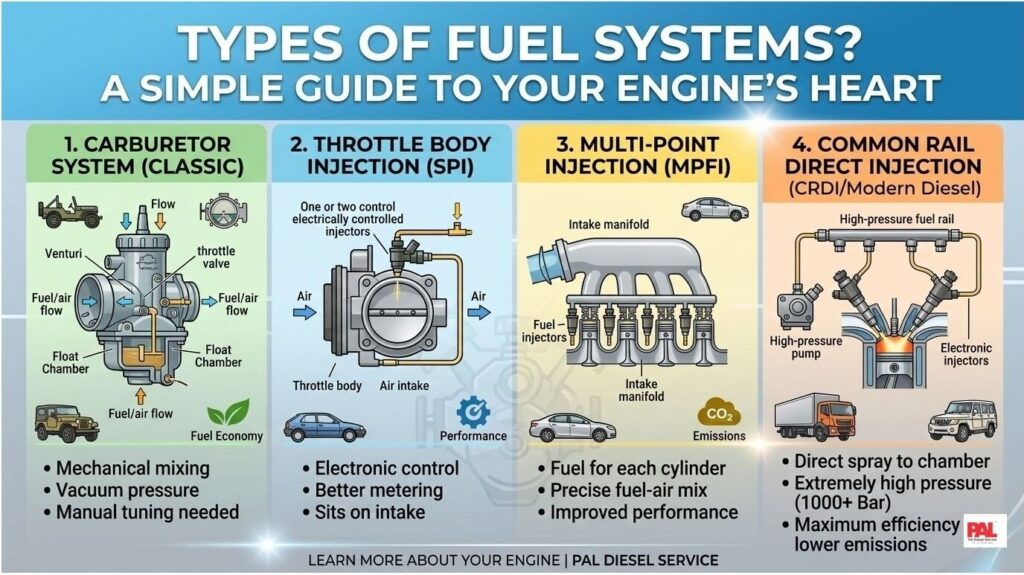
If you’ve ever wondered how your vehicle turns a tank full of liquid fuel into the power that moves tons of metal down the highway, you’re looking at the magic of the fuel system. At Pal Diesel Service, we see engines of all shapes and sizes. While technology has changed drastically over the decades, almost every internal combustion engine – whether it’s a rugged Mahindra Bolero or a heavy-duty Ashok Leyland truck -uses one of four primary fuel delivery methods. Understanding these systems doesn’t just make you a more informed owner; it helps you spot trouble before a small “hiccup” turns into a massive repair bill. Let’s break down the four types of fuel systems in plain English. 1. The Classic: Carbureted Fuel Systems If you own a vintage Jeep or an older motorcycle, you’re likely familiar with the carburetor. Before computers took over our dashboards, the carburetor was the mechanical “brain” of the engine. How it works: It uses vacuum pressure to suck fuel into the air stream as it passes through a narrow tube (the Venturi). The Downside: Carburetors are purely mechanical. They don’t adapt well to changes in altitude or temperature, which is why older cars often struggle to start on cold winter mornings in North India. Current Status: Mostly phased out in modern commercial vehicles in favor of efficiency and emissions control. 2. Single-Point Injection (Throttle Body Injection) As the industry moved away from carburetors, Single-Point Injection (SPI) was the “bridge” to the digital age. It looks a lot like a carburetor but replaces the mechanical jets with one or two electrically controlled fuel injectors located at the throttle body. The Benefit: It provided better fuel metering than a carburetor and was much more reliable. The Limitation: Because the fuel still had to travel through the intake manifold to reach each cylinder, some cylinders would inevitably get more fuel than others, leading to slight inefficiencies. 3. Multi-Point Fuel Injection (MPFI) MPFI was a game-changer for petrol engines and early light-diesel systems. Instead of one central injector, this system gives every cylinder its own injector. Why it’s better: By placing the injector right outside the intake valve of each cylinder, the engine can “breathe” better. This results in: Better fuel economy. Smoother idling. Quicker throttle response. Common Use: You’ll find variations of this in many passenger cars and older generations of light commercial vehicles. 4. Direct Injection & Common Rail (The Modern King) This brings us to the “Gold Standard” for modern diesel engines – the systems we specialize in here at Pal Diesel Service. In a Direct Injection system, the fuel is sprayed directly into the combustion chamber at incredibly high pressure. In diesel engines, this is known as Common Rail Direct Injection (CRDI). The Secret Sauce: A high-pressure pump keeps a “rail” full of fuel at massive pressure (up to 2,000+ bar). The injectors then fire multiple times during a single combustion stroke with micro-second precision. Why we love it: Incredible Torque: Essential for heavy-duty hauling. Lower Emissions: Meets BS4 and BS6 standards. Quiet Operation: Gone are the days of the “clattering” loud diesel engine. Why Does the System Type Matter to You? Every system has its own “personality” and maintenance needs. For instance, a Mahindra Pickup using a CRDI system requires much cleaner fuel and more precise calibration than an old mechanical pump engine. Common signs your fuel system needs a check-up: Hard Starting: If it takes 3-4 cranks to fire up. Black or White Smoke: A clear sign of poor fuel atomization. Engine Knocking: Often caused by “lazy” injectors or a struggling high-pressure pump. Trust the Experts Whether you are dealing with a loss of power in your Tata Harrier or need a precision calibration for an Ashok Leyland BS4 pump, the team at Pal Diesel Service is here to help. Modern fuel systems are high-tech masterpieces – they deserve high-tech care. Need a quote for a pump or injector service? Reach out to us today and let’s keep your engine running at its absolute best!
What are the 4 Types of Fuel Systems? A Simple Guide to Your Engine’s Heart Read More »